The government has directed residents’ welfare associations (RWAs), housing societies, government and private establishments, contractors and agencies to ensure that no person engaged or deployed by them resorts to open burning during winter, warning that such entities will be held liable for violations.
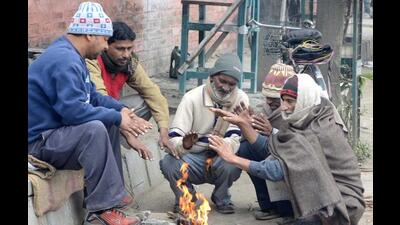
“Open burning of biomass, leaves, municipal solid waste, plastic, rubber, or any other combustible material, whether for heating or for any other purpose, is strictly prohibited,” the environment department said, in an order dated December 24.
The order also added that the RWAs, housing societies and other entities will be responsible for providing “adequate heating arrangements (via electric/approved fuels)” for staff engaged in security, sanitation, horticulture and other services.
“These directions shall come into force with immediate effect and shall remain applicable throughout the winter season and for such period as adverse air quality conditions persist or until further orders. Any violation of these directions shall be punishable under Section 15 of the Environment (Protection) Act, 1986, without prejudice to any other action permissible under law,” the order further warned.
The move comes amid persistently high pollution levels in the Capital and a sharp jump in complaints of open burning. The order noted that Delhi’s annual average PM10 and PM2.5 levels in 2024 were 225 µg/m³ and 110 µg/m³ respectively — already above the defined National Ambient Air Quality standards (NAAQS). Further, PM10 and PM2.5 from October 2024 to January 2025 peaked at 420 µg/m³ and 271 µg/m³, respectively, with the air quality index frequently slipping into the “very poor” to “severe” categories.
“Grievances with respect to open biomass and waste burning received on the Green Delhi app increased by 73.03% during October 2024 to January 2025 (winter period) in comparison to 26.95% in summer period,” the order mentioned.
Citing a study by the Indian Institute of Technology (IIT) Kanpur, the order mentioned that biomass burning contributes about 16.7% to PM10 and 25.8% to PM2.5 in winters and about 6.8% to PM10 and 12.2% to PM2.5 in summers.
It also pointed at directions issued by the Commission for Air Quality Management (CAQM), which has already directed RWAs to provide electric heaters to staff during “very poor” air quality days to prevent open burning for heating. The National Green Tribunal, in a 2015 order, had also imposed a compensation of ₹5,000 on anyone found burning garbage, leaves, plastic or similar materials in the open, the document recalled.
Invoking powers under Section 5 of the Environment (Protection) Act, 1986, the environment department under the state government has now made supervisory entities explicitly accountable for compliance.
RWAs have raised several practical problems surrounding the move.
“Even if a heater is provided to a security staff, where do we bring the electricity connection or the funds for the same? Either the government needs to empower RWAs to pay the electric bills or they need to step in themselves. RWAs are ready to cooperate but they cannot be held responsible for half baked ideas, with no practical approach,” BS Vohra, president of east Delhi RWAs joint front, said.
Further, RWA members said that a public welfare measure cannot simply be offloaded onto citizens for implementation.
“The most important step that the government keeps skipping is consulting all stakeholders. They should have consulted RWAs before passing off their responsibility, as we would have pointed out the myriad of problems surrounding this move,” Chetan Sharma, chairman of the Federation of GK-2 Complex RWAs, said.
Sharma added, “There has to be proper planning and budgeting for this. Besides, even if connections are given, proper monitoring also has to be done to prevent misuse. How can individuals be responsible for this, when clearly this requires state-level planning along with involvement of local authorities like MCD for execution.”