Maharashtra deputy chief minister Eknath Shinde on Sunday announced that no additional toll would be levied for using the Pune-Mumbai Missing Link project, and that existing toll rates at the Khalapur toll plaza would remain unchanged. The project is set to be inaugurated on Maharashtra Day on May 1.
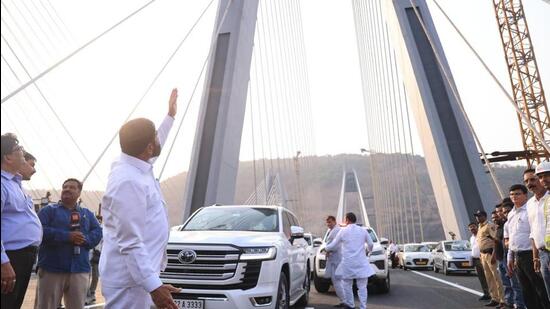
Shinde said the decision was taken to ensure that commuters benefited from faster connectivity without added financial burden. “The objective of the project is to reduce travel stress and improve connectivity, not increase costs for commuters,” he said.
The government will adopt a phased approach to the use of the new stretch. “For the first six months, cars, light vehicles and buses will be prioritised on this route,” said Shinde. “Heavy vehicles will be restricted initially to ensure smooth traffic flow and maximise commuter benefit.”
The 13.30-km Missing Link project will substantially reduce the current travel stretch and time by largely bypassing the congested and accident-prone ghat section of the expressway. The existing 19.8-km route between the Khopoli exit and Sinhgad Institute stretch will be reduced to around 13.3 km, cutting the distance by more than six kilometres and 30 to 45 minutes of travel time between Mumbai and Pune. “This will result in fuel savings of nearly ₹1 crore daily, reduced pollution and a safer journey,” said Shinde.
The deputy CM described the project as a major engineering achievement executed under extremely challenging conditions. “In Tiger Valley, where the viaduct rises 182 metres high, wind speeds exceed 70 kmph and the area remains covered with fog, rain and storms for most of the year,” he said. “Despite these conditions, MSRDC successfully completed this ambitious project. Only minor finishing work on the tunnel and viaduct is pending, and will be completed in the next few days.” Highlighting the project timeline, Shinde noted that the proposal had received approval in 2019 when Devendra Fadnavis was the chief minister and Shinde was handling the Maharashtra State Road Development Corporation. “It is a coincidence that the inauguration is taking place at a time when Devendra Fadnavis is again the chief minister and the department is with me,” he said.
Shinde also highlighted the global standards adopted during construction. “The cables used for the bridge were imported and tested in Vienna, while the wind tunnel testing was carried out in Denmark to ensure structural stability under extreme conditions. The bridge has been designed to withstand wind speeds of up to 260 kmph,” he said.
The project execution itself posed major logistical challenges. “There was initially no access road to the valley,” Shinde pointed out. “An approach route had to be created from the Wakan-Pali-Khopoli side to transport heavy machinery. Around 12,000 metric tonnes of steel were used for temporary support structures and work continued despite heavy rain, strong winds and dense fog.”
The project includes two tunnels measuring 1.67 km and 8.92 km, constructed through the Sahyadri basalt rock by using advanced tunnelling techniques. Shinde said the tunnels were equipped with modern safety infrastructure, including CCTV surveillance, SOS call boxes, fire suppression systems, cross passages every 300 metres and a 24-hour monitoring control room. He added that access-controlled corridors such as this one played a crucial role in boosting economic growth. “Better connectivity accelerates development,” he said. “We have seen this with the Mumbai-Pune Expressway and Samruddhi Mahamarg. Similar road networks are now being expanded across Maharashtra, including towards the Konkan region.”
The project incorporates design elements inspired by nearby forts such as Lohagad, Visapur and Tikona along with motifs drawn from the Karla caves. Describing it as a blend of engineering excellence and regional heritage, Shinde said durable GRC material was used for the structures, which were designed to last for over 100 years.
Regular commuters welcomed the announcement, particularly the assurance that no additional toll would be imposed. Pune-based IT professional Sumedh Karanje said, “If the project actually cuts down travel time by 30 to 45 minutes and reduces congestion in the ghat section, it will be a huge relief for frequent travellers.” Mumbai resident Harish Mundada added, “The fact that there is no additional toll is a major advantage. A faster journey at no extra cost will make a big difference to regular commuters between Mumbai and Pune.”