MUMBAI: Deonar, Mumbai’s vast dumping ground in the eastern suburbs, usually enters public consciousness as data: tonnage figures, court deadlines, drone shots of smouldering hills. It is seen from above, discussed from a distance, and forgotten just as quickly. At Priyasri Art Gallery’s Necropolis of Remains, presented during Mumbai Gallery Weekend, those same mountains of waste are stripped of abstraction. They are rendered intimate, human and disturbingly alive, asking viewers not what Deonar is, but what the city chooses not to see.
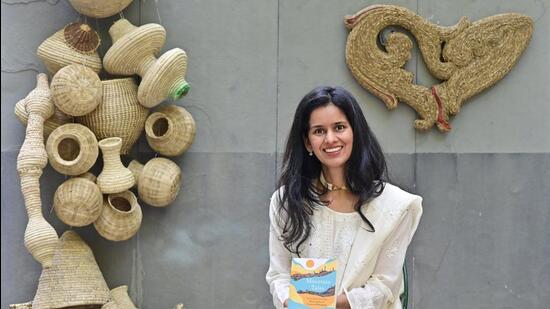
Mumbai, India – Jan. 11, 2026: Author Saumya Roy, during a conversation at Priyasri Art Gallery, Kathiwada City House, as part of Mumbai Gallery Weekend, ahead of the exhibition “Necropolis of Remains” inspired by Roy’s book Mountain Tales in Mumbai, India, on Sunday, January 11, 2026. (Photo by Anshuman Poyrekar/Hindustan Times) (Anshuman Poyrekar/HT Photo)
Taking its cue from Mountain Tales, journalist Saumya Roy’s deeply reported account of life in and around the Deonar landfill, one of Asia’s largest dumping grounds and one of Mumbai’s most wilfully ignored realities, the exhibition treats the book not as a script but as a provocation. What emerges is not a literal retelling of Deonar, but a layered excavation of waste as material, memory and politics.
The exhibition brings together nine young artists, Arun B, Aasha Keshwala, Hina Bhatt, Raka Panda, M D Mussthafa, Rashesh Chauhan, Simran Chowdhury, Subhasmita Ghadei, and Suraj Kamble, all students or recent graduates of The Maharaja Sayajirao University of Baroda. Each was given Roy’s book as a starting point, not as a script to illustrate, but as a provocation. What emerges is not a literal retelling of Deonar, but a layered excavation of what waste means, materially, politically, and emotionally.
During a Sunday morning discussion between the showcase, Roy was in dialogue with writer and curator Anish Gawande, who framed Mountain Tales not merely as reportage, but as a book that reveals how garbage mountains are shaped by the city’s consumption, its inequalities, and its administrative delays. “When we think of Deonar, we think of it as a headline or a statistic,” Gawande noted. “But in this book, the mountains come alive, beautiful in an eerie way, and deeply unsettling.”
Roy spoke candidly about how her decade-long engagement with Deonar began, not as a literary project, but through her work with a microfinance organisation whose borrowers were waste pickers. What struck her first was not just the physical toll of labour, bruised hands, damaged feet, but the strange pull the landfill exerted. “People would tell me they fell sick if they didn’t go to the mountain,” she recalled. “There was an almost addictive relationship with the place.”
She also reflected on how faith and imagination become tools for survival in a landscape defined by danger and uncertainty, explaining how religious imagery often stands in for emotions that trauma makes difficult to articulate. Children working night shifts on an unlit landfill spoke casually of spirits and apparitions—not as fantasy, but as the only language available to describe what it means to move through mountains of garbage at two in the morning, without any lights guiding them.
That tension, between brutality and attachment, despair and dignity, runs through the exhibition. The works here resist easy moral binaries. Instead, they sit in the uncomfortable space Roy describes so vividly in her writing: a world where birthdays are celebrated beside toxic smoke, where faith and folklore help make sense of trauma, and where the promise of finding something valuable, metal, plastic, a shard of possibility, keeps people returning to the dump.
Several artists engage directly with material memory. Arun B’s sculptural works feel compressed and eroded, as if shaped by pressure over time, echoing the physical weight of accumulated waste. Hina Bhatt, working with ceramics, draws attention to the fragile dignity of marginalised labour, transforming everyday forms into quiet acts of resistance. Raka Panda and Simran Chowdhury reflect on consumption and invisibility through painterly surfaces that oscillate between documentation and metaphor; while M D Mussthafa’s work carries the emotional residue of Deonar’s landscape, at once haunting and achingly familiar.
Importantly, Necropolis of Remains does not aestheticise suffering. If anything, it complicates it. As Roy pointed out during the discussion, the temptation, especially for outsiders, is to romanticise darkness. Her own challenge as a writer, she said, was to stay truthful to her lived experience of Deonar, which was not only about decay but also about joy, humour, generosity, and community. “In my memory, it was not a place of awfulness,” she said. “It was a place full of life.”
That insistence on complexity carries through the exhibition. The landfill is not presented as an inert site of failure, but as a living system, one shaped by policy paralysis, court cases stretching back decades, and the city’s relentless growth. Garbage, as the exhibition text reminds us, is never neutral. It raises uncomfortable questions: Who owns waste? Who profits from it? And who is left to live with its consequences?
For Priyasri Patodia, founder of Priyasri Art Gallery, the exhibition is part of a long-standing commitment to working with archives, texts, and young artists to reframe dominant narratives. Speaking about why she chose Mountain Tales as the starting point, Patodia emphasised that this was not about positioning students as underdogs, but about giving them a serious intellectual invitation. “History is often written by those with power,” she noted. “As gallerists and patrons, our role is to open eyes, to allow the next generation to form its own opinions.”
Necropolis of Remains by Priyasri Art Gallery was on view at Kathiwada City House, Worli, Worli, from January 8 to 11, as part of Mumbai Gallery Weekend.