MUMBAI: Underlining that delay in justice erodes its very foundation, Chief Justice of India (CJI) Surya Kant said on Saturday that high courts must function as vigilant constitutional courts that actively respond to systemic failures in the rule of law, instead of waiting for individual litigants to seek relief.
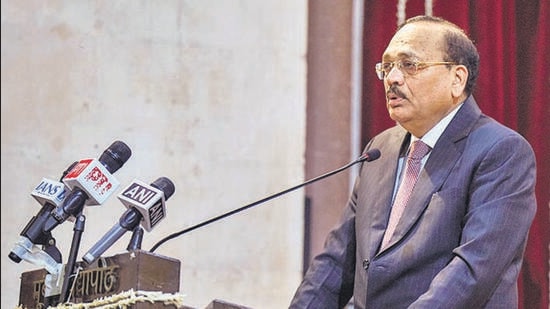
“Justice delayed is not only justice denied, but it is justice destroyed,” the CJI said, as he urged high courts to view access to justice as a state-guaranteed service rather than a passive entitlement.
Speaking at the Fali Nariman memorial lecture at Mumbai University, the CJI said high courts should go beyond their traditional appellate or revisional roles and function as accessible forums for constitutional remedies.
Referring to Article 226 of the Constitution, which empowers high courts to enforce fundamental rights, he said they are independent constitutional courts and should not be treated as mere stepping stones to the Supreme Court.
“High courts are the primary sentinel guarding the doorsteps of the ordinary citizen, ensuring that the rule of law is not a distant concept but a localised, breathing reality,” he said, adding that it is often the high court that hears the first cry of injustice—whether it concerns illegal detention, denial of dignity, or administrative inaction. “While the Supreme Court may have the final word, the high court often has the most vital one,” the CJI said.
Placing Article 226 in historical context, the CJI said India’s constitutional design must be read against its colonial past, when laws were used to suppress liberty. This, he said, reinforced the lesson that rights without effective remedies are hollow—a realisation that shaped the broad remedial reach of the provision.
CJI Kant further said that the evolution of public interest litigation marked a moral shift in constitutional adjudication, allowing public-spirited individuals and organisations to approach high courts on behalf of those silenced by poverty, illiteracy or marginalisation. The power of courts to act suo motu (on their own), exercised with restraint, further strengthens the high courts’ role in delivering substantive justice, he added.
“When the law is silent, the sentinel does not remain mute,” he said, citing judicial interventions to protect the environment, uphold the dignity of prisoners, and secure the rights of migrant workers during national crises.
Emphasising the need for institutional evolution, the CJI said high courts must adapt to the digital era, particularly as citizens’ rights are increasingly affected by automated systems and emerging technologies. Virtual hearings, he said, should move beyond being treated as emergency measures and be used to enhance accessibility, affordability and equality in justice delivery.
He also flagged the need for procedural innovation to bridge what he described as the “right-remedy gap”, recalling Fali Nariman’s criticism of verbose litigation and suggesting more streamlined adjudication for clear-cut writ matters.
The CJI cautioned against the growing tendency of litigants, particularly the affluent and privileged, to bypass high courts and directly approach the Supreme Court under Article 32. “People who are rich and privileged should not think that they have direct access to the Supreme Court merely because Article 32 of the Constitution allows it,” he said.
Concluding his speech, the CJI said high courts must remain alert to systemic breakdowns in governance and legality and not wait passively for litigants to knock on their doors. Article 226, he said, remains the lifeline of access to justice, ensuring that liberty in India is never again left at the mercy of unchecked authority, with high courts standing vigilant as sentinels of constitutional freedom.
Later in the day, CJI Kant was felicitated by the Bombay High Court and the Maharashtra government. Deputy chief minister Eknath Shinde praised the CJI’s journey from a middle-class background in Haryana to the country’s top judicial office, describing it as an inspiration for the youth. He also remembered several important judgements passed by the CJI during his tenure at the Supreme Court and applauded him for his honesty and integrity.