Mumbai: “Eknath Shinde is a political case study,” says a senior Maharashtra BJP leader. He should know what he is talking about, having just emerged, somewhat bruised from Shinde’s headlock during seat negotiations for the January 15 BMC elections.
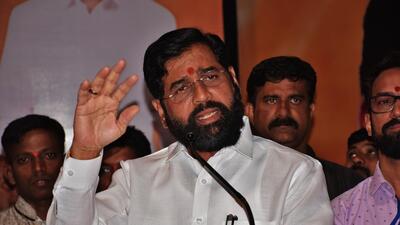
The BJP, riding high following a slew of successfully-executed infra projects, began negotiations with an offer of 52 seats to Shiv Sena for the 227-seat House. The alliance that was sealed on the final day of nominations on Tuesday was 137 seats for the BJP and 90 seats for Shinde. “He is hard, steadfast and relentless during negotiations,” says one of his close aides.
Few politicians in India have had as meteoric a rise as Eknath Shinde. The 61-year-old split the Shiv Sena in mid-2022, toppled a government and negotiated with a dominant BJP to become Maharashtra’s chief minister.
In the three and a half years since, he has cemented his position such that the BJP can neither ignore him nor swallow him up. With the chutzpah of a Robin Hood and the largesse of a Santa Claus, Eknath Shinde has fashioned a new party that has emerged as a significant political player, and not just in Maharashtra.
The former chief minister is aware that the 2026 civic elections will alter the balance of power in the state. And the key to doing well is to do well in the seven corporations of the Mumbai Metropolitan Region. “Shinde will have to get the urban Maharashtra’s nod if he wants to emerge as a major regional leader,” says political commentator Prakash Akolkar.
In Navi Mumbai, for instance, his parleys with strongman Ganesh Naik have plunged the local BJP unit into chaos. Even though Naik, something of a political weather-cock, heads the BJP unit there, he remains at odds with old-time senior BJP loyalists in Navi Mumbai. So even though the BJP and the Shiv Sena are contesting Navi Mumbai’s 111 seats independently, BJP leaders accuse Naik of having worked out a separate deal with Shinde. Likewise, Shinde bargained for additional seats in his stronghold of Thane with the state BJP chief Ravindra Chavan, and in turn, offered Chavan a greater share in Kalyan-Dombivali which is the latter’s stronghold.
These parallel deals he cuts with local strongmen combined with his direct access to Amit Shah in Delhi has often frustrated the BJP leadership in Mumbai. During 2025 alone Shinde had as many as seven closed-door talks with Shah in New Delhi. Shah recently summoned state BJP president Ravindra Chavan, who had begun to act tough with Shinde over seat-sharing for the Dombivli-Kalyan civic elections, to New Delhi and asked him to go soft on Shinde and hold parleys with him, which Chavan promptly did.
In addition, the party is worried about Shinde’s growing reach in Maharashtra’s rural areas. In the recent municipal council polls, the Shiv Sena emerged as the clear number two party bagging 1,052 municipal council seats.
“Shinde’s party lacks a robust organisational structure or the kind of state agencies that the BJP has under its belt and yet the party did exceedingly well in southern Maharashtra and Marathwada. It also garnered a decent vote share in Konkan which is the Thackerays’ bastion,” said a senior BJP lawmaker.
There has also been grumbling within the BJP at Shinde’s brazen heist of the Ladki Bahin Yojana, originally a BJP scheme, which he renamed as the Mukhya Mantri Ladki Bahin Yojna and wooed a significant chunk of Maharashtra’s women voters.
These successes have only whetted Shinde’s appetite, said the BJP lawmaker. “In the negotiations for the BMC, he kept asking for more and more. In addition to a large number of seats, he also wanted three stints of the standing committee chairmanship spread over the next five years if we win.” It is the standing committee that handles the Rs. 74,000 crore-plus BMC budget, and distributes civic contracts running into hundreds of crores.
Shinde was helped in the negotiations by the new-found alliance of the Thackeray cousins. He kept arguing that he would need more seats in the Marathi-dominated wards to keep the Sena (UBT) and MNS at bay. “Although we may contest fewer seats as part of the Mahayuti alliance, our strike rate will be exceptionally high,” Shinde recently said while addressing a party conclave at Ulhasnagar.
However, the catch here is that while the Shiv Sena is ready—prompted by sheer survival instinct—to cross swords with the Sena (UBT)-MNS alliance, hawks in his party worry that the BJP may not want Shinde to score over the Thackerays in any significant manner, and thus keep him in check.
“The BJP wants the Uddhav-Raj combine to win as many BMC wards as are necessary to reclaim Balasaheb Thackeray’s legacy. This makes Shinde’s task to be Balasaheb’s true political heir difficult,”says Akolkar, adding that trust deficit is the biggest crisis besetting the Mahayuti. At the same time, Shinde often likes to say, “Mala halkyaat ghevoo naka’ (‘Don’t take me lightly’).”
Meanwhile, Shinde’s karyakartas pointed out that his demand for more BMC seats was rooted in practical politics. “The deputy CM has to re-nominate nearly 60 former Shiv Sena (undivided in 2017 when the BMC polls were held) corporators who joined his party after his July 2022 mutiny. Those denied party tickets may turn rebels, thus adding to our woes,” said a former corporator and Shinde loyalist.
Inquiries revealed that quite a few defectors who are unsure of their political future are getting restless in the Shiv Sena. “Many new entrants, especially those from the Shiv Sena (UBT) think that the process of assimilation in the Shinde Sena is painfully slow,” he added.
While admitting that the Shiv Sena is yet to firm up its organisational structure, Shiv Sena leader Sheetal Mhatre who works closely with Shinde, said, “The party was busy with three back-to-back elections between 2024-2025. Hereafter we will get down to streamlining our organisational structure.”
Shinde’s detractors have often accused him of deepening Maharashtra’s money-bag culture and vitiating the democratic process. “Shinde has caught the imagination of young Marathis who want fast money and instant gratification. They adore him for grabbing the opportunity to overnight become the CM in 2022,” said Akolkar. But it comes at a cost, he cautions.
Sheetal Mhatre was quick to contest the charge. “Shindesaheb is not a filthy rich politician, but his ability to raise resources is formidable.” Stories of Shinde’s munificence (‘daanat’ is one of his favourite words) are legion. According to Vivek Surve, a law graduate and professional, “Shinde’s ‘daanat’ is a raw version of state welfarism and cash transfer schemes which voters have begun to like.”
“The question is not if Shinde has over a thousand crore in his bag or not. The fact is that he is liberal with funds when it comes to helping party workers and that matters a lot,” said a Shinde karyakarta.
Shinde’s rural background, his rise from an autorickshaw driver to the upper echelon of power, and his sharp survival instinct have enabled him to decipher the subtleties of the post-2010 politics. Be they loss of ideology, welfarism, the power of money in elections or mobocracy. However, he too, like many of his peers, is all too aware of the fragility of rag-tag politics marked by shifting loyalties and brittle pacts, and is looking to strengthen the ground beneath his feet.