From early screening of newborns to expanded insurance coverage and the completion of delayed hospital infrastructure, Delhi’s 2026-27 budget signals a push towards more accessible, preventive health care system in the Capital.
The budget, which chief minister Rekha Gupta presented in the Delhi assembly on Tuesday, allocated ₹13,034 crore under the medical and public health sector – 12.57% of the total outlay – making it the second-largest share after education. The allocation is marginally higher than last year’s ₹12,893 crore.
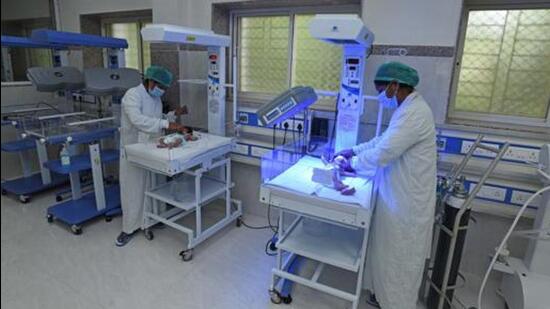
At the centre of the preventive care push is “ANMOL (Advanced Newborn Monitoring and Optimal Life Care)”, a scheme that will provide 56 diagnostic tests for all newborns in the Capital free of cost across government and private hospitals.
“With just one drop of blood, there will be 56 types of testing of newborns, all done completely free,” Gupta said. The programme, aimed at early detection of genetic and congenital disorders, has been allocated ₹25 crore.
Expanding health-care access, the government also brought transgender residents under the Ayushman Bharat Pradhan Mantri Jan Arogya Yojana (AB-PMJAY), addressing long-standing barriers to affordable treatment. “The biggest problem for them is getting treatment… they often do not have documents or are not placed under any proper category, forcing them to turn to private hospitals,” Gupta said.
The AB-PMJAY scheme, rolled out in Delhi in April 2025, has already been extended to Antyodaya ration card holders, ASHA and Anganwadi workers, and widows, covering around 750,000 beneficiaries with an outlay of ₹202 crore, the CM said.
Alongside coverage expansion, the budget also emphasises capacity building. The government plans to operationalise 750 new Ayushman Arogya Mandirs as part of a larger target of 1,139 such facilities across the city, Gupta said. She also announced 11 integrated public health laboratories and nine critical care blocks, in addition to a new trauma centre at Guru Teg Bahadur Hospital with central assistance of ₹200 crore.
A significant portion of the push is directed at completing stalled infrastructure. Projects at hospitals in Madipur, Hastsal and Jwala Puri will be taken up with an allocation of ₹515 crore, while seven pending ICU blocks will be completed with ₹150 crore.
Under the Centre’s special assistance to states for capital investment (SASCI) scheme, the government will upgrade infrastructure at major hospitals including Rao Tularam Memorial Hospital, Babasaheb Ambedkar Hospital and Lal Bahadur Shastri Hospital, while construction will be completed at Lok Nayak Hospital and Satyawadi Raja Harishchandra Hospital.
To strengthen service delivery, ₹787 crore has been earmarked for procurement of medical equipment, medicines and machinery, along with a matching allocation for additional health-care supplies.
The government also announced a real-time hospital bed-tracking system to improve emergency response and reduce delays in accessing care.
“This system is being launched so that people can check the bed availability in real-time and not run from one hospital to another for beds,” she said.
A digital blood bank and donor registry will be set up to streamline access to blood units across the city.
The budget also focuses on medical education, with plans to increase undergraduate seats from 595 to 820 and postgraduate seats from 553 to 572. A new medical college will be established at Indira Gandhi Hospital in Dwarka with an allocation of ₹50 crore.
In the AYUSH sector, the Delhi State Ayush Society will expand its footprint with five new centres backed by ₹60 crore.