Mumbai: Ahead of the Tata Mumbai Marathon the city’s air quality has once again become a point of concern, with environmental group Awaaz Foundation urging civic and pollution control authorities to put health safeguards in place for runners, volunteers and spectators.
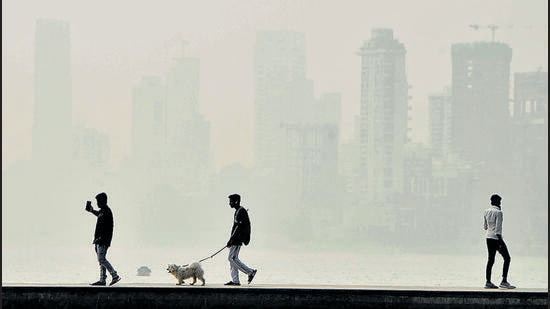
In a letter sent on Monday to the Brihanmumbai Municipal Corporation (BMC) and the Maharashtra Pollution Control Board (MPCB), the foundation flagged deteriorating air quality across Mumbai since the beginning of January, marked by haze-like conditions in several parts of the city. With the marathon scheduled for January 18, the foundation has sought early, route-specific air quality monitoring and transparent sharing of data.
“Air quality has been deteriorating over the last few years, and the marathon is always held in January, when winter conditions and weather patterns tend to worsen pollution,” said Sumaira Abdulali, founder of Awaaz Foundation. “What is particularly worrying is PM2.5, which is easily inhalable and penetrates deep into the lungs. When people run a marathon, their inhalation rate increases significantly, so it becomes important to know exactly what levels of PM2.5 they are breathing in along the route.”
Abdulali referred to the foundation’s monitoring exercise conducted along the marathon route last year, which found PM2.5 levels well above prescribed limits at multiple locations during the early morning hours, when the race is usually held. The findings showed PM2.5 concentrations ranging from 95 µg/m³ to over 150 µg/m³ at several locations, far exceeding the Central Pollution Control Board’s 24-hour standard of 60 µg/m³.
After the 2025 marathon, MPCB deployed mobile air quality monitoring vans along parts of the route to measure pollution levels after the event and found high readings.
The foundation has now requested that MPCB deploy its mobile monitoring vans along the entire route several days in advance, with a focus on early morning PM2.5 readings, and that the findings be shared publicly and with health authorities and marathon organisers.
“They should deploy their vans along the route now and inform participants of the AQI. Warning people and asking them to take precautions is the bare minimum,” she said, adding that construction work and other polluting activities along the route could also be temporarily halted.
In response to the letter, the BMC forwarded the complaint internally for necessary action on the directions of the additional municipal commissioner (environment and special projects).
“Over the last six to seven days, air quality levels have largely remained in the range of 110 to 114 at several locations. Some of the higher readings seen on non-reference instruments cannot be relied upon as official data. At times, PM2.5 levels have crossed 200 in areas such as Deonar. The MPCB has mobile monitoring vans with proper reference-grade instruments, and they can deploy them if required. For the next year, once a more comprehensive plan is in place, we are confident levels can be kept below 100,” a senior BMC official said.
“Last year, when we tried deploying mobile monitoring vans, there were logistical and security issues. We did not receive permission to station them on roads due to traffic concerns, and the power supply was unavailable. The vans are ready, but deployment requires coordination, a fixed location, and electricity. We have already spoken to BMC on this, and we are trying to navigate the issue,” a senior MPCB official said.
Procam International, the organiser of the marathon issued a statement on Monday saying that the Tata Mumbai Marathon is anchored in a strong sense of responsibility towards the city that hosts it. Neha Kandalgaonkar, vice-president of corporate communications at Procam said, “Working closely with the BMC and other civic authorities, we implement targeted measures during the event window, including intensive road cleaning, dust suppression through mist blowers and water sprinkling, real-time environmental monitoring, and early-morning race scheduling to optimise conditions for runners.”
Kandalgaonkar added that this year, the Mumbai Police has facilitated a coastal route that offers an added natural advantage with the early-morning sea breeze supporting air movement during race hours and contributing to more comfortable running conditions. “Participant safety is further strengthened through a comprehensive medical preparedness plan, with robust medical infrastructure deployed across the course and at the finish area in partnership with Sir H.N. Reliance Foundation Hospital,” she said.