Panic gripped residents of Chayansa village on Monday after authorities in Haryana’s Palwal district declared a health emergency following at least six deaths linked to liver-related complications in recent weeks.
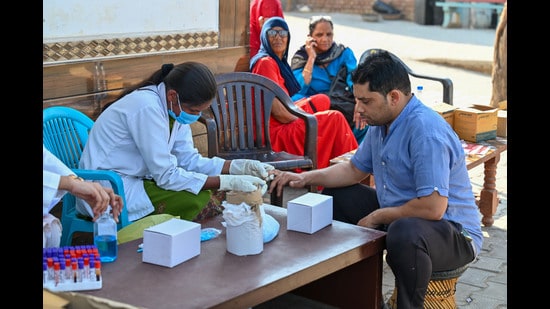
Mohammad Ismail, the village sarpanch, said fear has spread steadily since the first reported case on January 14. “Since then, the entire village has been living in fear. One after another, 15 people have died,” he said.
He added that most households rely on RO water for drinking.
“Initially, many people had diarrhoea and doctors suspected food poisoning or water contamination, but no report confirmed this. Now we are being told the deaths are due to blood-borne diseases like Hepatitis B, C and even HIV. We need urgent attention so the infection does not spread further,” Ismail said.
For many families, the crisis has become deeply personal. Mohammad Tahir, whose 14-year-old nephew died of jaundice with hepatic encephalopathy and liver failure on January 29, said limited access to healthcare worsened the situation. “He developed fever and within 24 hours his condition deteriorated. We had to rush him out of the village for treatment, but he died. If proper facilities were available at the government clinic, my nephew could have survived,” he said.
Mohammad Nahid, father of 16-year-old Huma, who died on February 3 due to jaundice with acute liver failure, said the family had no warning of the severity. “My daughter had jaundice, but we never imagined it would become so serious. Her condition worsened very fast. We kept running from one hospital to another, but we could not save her. We want to know how such a disease spread in our village,” he said.
Hasmuddin Khan, whose 22-year-old son Dilshad died on February 11 and later tested positive for Hepatitis B, echoed the concern. “My son was young and earning for the family. We had no idea such an infection was spreading here,” he said.
Meanwhile, parallel testing of drinking water has added to anxiety. Of 107 household samples tested, 23 failed quality checks due to bacterial contamination and inadequate chlorination. Coliform bacteria were found in several underground storage tanks.
Residents depend on a mix of limited municipal supply, underground storage, tanker water and RO water sourced from neighbouring areas. Authorities have distributed around 15,000 halogen tablets for water purification and activated a helpline to assist villagers.